Camp was thick with mist when we woke on a damp strangely quiet morning. Spiders’ webs moist with dew covered the bushes, looking like the branches had caught wisps of the mist.
We drove for several hours along roads alternating between muddy pools and deep sand, the road lined with villages that emerged like lost outposts in the fog: round huts with vertical branch supports, thatched roofs and donkey pens walled with slanted branches, many empty but several corralling a few animals. Hoof prints scored the road.
The dull dampness seemed endless as we slogged on. Bob and Karen and I were beneath the broken section of nets and with every bump we raised our arms to support the mass above us – but still things rained down on us, including the missing tea strainer, a glove, Nikki’s white frisbee, which we threw around in the back of the truck to squeals, shrieks and hysterical laughter.
The whole landscape was shrouded in grey, the feathery weeds in the fields almost blurring into the colourless sky, the only highlight being the sparkling spiders' webs and dew on the leaves. At one point Kel queried whether we were driving in the right direction. Bob got his compass from his locker to help Kel check where we were. Having struggled all morning, the sun finally broke through the canopy.
We finally reached Maun, where we set up camp at the Safari Lodge before visiting the town. The lodge is a pleasant collection of buildings – all thatched along the edge of an arm of the delta, which is very low at present. It's got a bar, restaurant, office/souvenir shop, half dug pool, a scattering of rooms/huts, dogs, cats, crows, black workers, the owner’s children, and a cheetah in a large compound. We booked wildlife spotting canoe trips for tomorrow and a scenic flight on Sunday.
Did some laundry before heading into the very small metropolis of Maun.
And here we saw our first Herero women from Namibia (southwest Africa) dressed traditionally in their Dutch-influenced full gathered skirts., shawls and head scarfs in bright colours, many carrying swathed babies. Passing villages on the road coming back out of town we a bright-red carcasses of freshly slaughtered meat hanging from a tree.
Nearly all the Botswanans and the people we've seen in the last few countries through which we've travelled no longer wear traditional clothing; they dress in strange combinations of western skirts, dresses, frilly blouses, So the bright Hereros in their Colonial attire were a surprise and strangely bizarre in the heat.
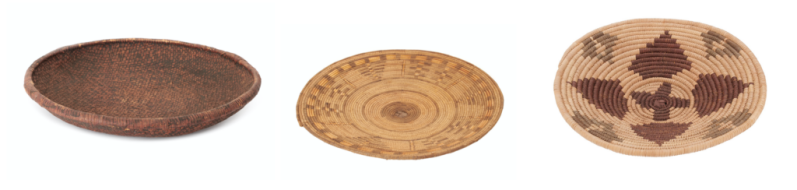
We detoured to the Basket Exhibition at the airport, a fantastic but expensive souvenir shop with a large selection of gorgeous Botswanan baskets for sale (Botswana has a long tradition of basket weaving). Upstairs was a display of award-winning baskets woven in beautiful tones of browns – huge bowls, flat trays, lidded carriers - and wall displays of the making process and showing the inspirations for the patterns, including tortoises’ knees! Beautiful statues in stone and wood too but everything too expensive for me.
Back to camp – washing, nesting, writing – absolutely exhausted. Ventured to the bar to continue writing, where I chatted with some of our restaurateurs and the owner’s daughter and watched the play between the barmen and the younger blacks cleaning the table and the hierarchy at play: white people, older black staff and workers, the superiority of the white children, especially the girl; her younger brother was far more relaxed with the staff and less condescending to the juniors. The mother was very British but friendly and helpful.
Image courtesy of Brighton & Hove Museums UK - https://brightonmuseums.org.uk/discovery/history-stories/making-botswana-baskets/
Add comment
Comments