Feeling very low, bored, tired, supersensitive to anything and everything said to me. Spent most of the morning trying to sleep, though the roads were too rough for that a lot of the time. Felt no desire to mix with anyone on our truck and yearning to curl up with someone for a while and go nowhere and see nothing. The last few days have been hard with few respites and that's getting to me. Harder to be civil than just cut myself off for a while, so I put my Irish music tape in my Walkman and tried to escape from it all for a while. We drove through hard, compacted grey soil country with occasional deep sand drifts and tracks carved between thorn trees.
The people are markedly different here and exhibit a passion for tightfitting “sun dresses” in bright prints but not West African cottons. Lots of these are chiffon-like fabrics of obviously man-made fibres that must be very hot. And among the very black skins we've become used to are many paler faces that look almost Indian in their eyes and cheekbones.
Finally we reached Ndjamena, the Tchad capital, our expectations coloured by horror stories of 24-hour guards, hassles and a battle ravaged city. (From 1978 to 1987, Libya and its Chadian allies, and anti-Libyan Chadian groups supported by France, with the occasional involvement of other foreign countries and factions, waged a series of military campaigns in Chad collectively called the Chadian–Libyan War. Ndjamena fell in 1982 and again in March 1986, just days after we left!)
The Hotel Chadienne provided very few facilities for the 1000 Central African francs per head and using the crystal-clear swimming pool was another 500 CFA per head. A well-stocked but expensive bar and restaurant and a children's playground sat beside the pool but it took some exploration to find the toilet and shower area within the hotel; the man at the reception desk telling us to ask outside and the barman told us to ask reception. What we eventually found were four showers, two with heads and the one opposite the entrance lacking a door, and four flush toilets backed by slimy walls, the whole floor awash with cold water.
With the banks and post office shut until 3pm we were frustrated and penniless, again or still, many of us with small and large debts. Then a bloke arrived offering 360 CFA per US dollar against the hotel’s 350 rate, so Kel changed trip fun moneys and a few of us changed smaller amounts.
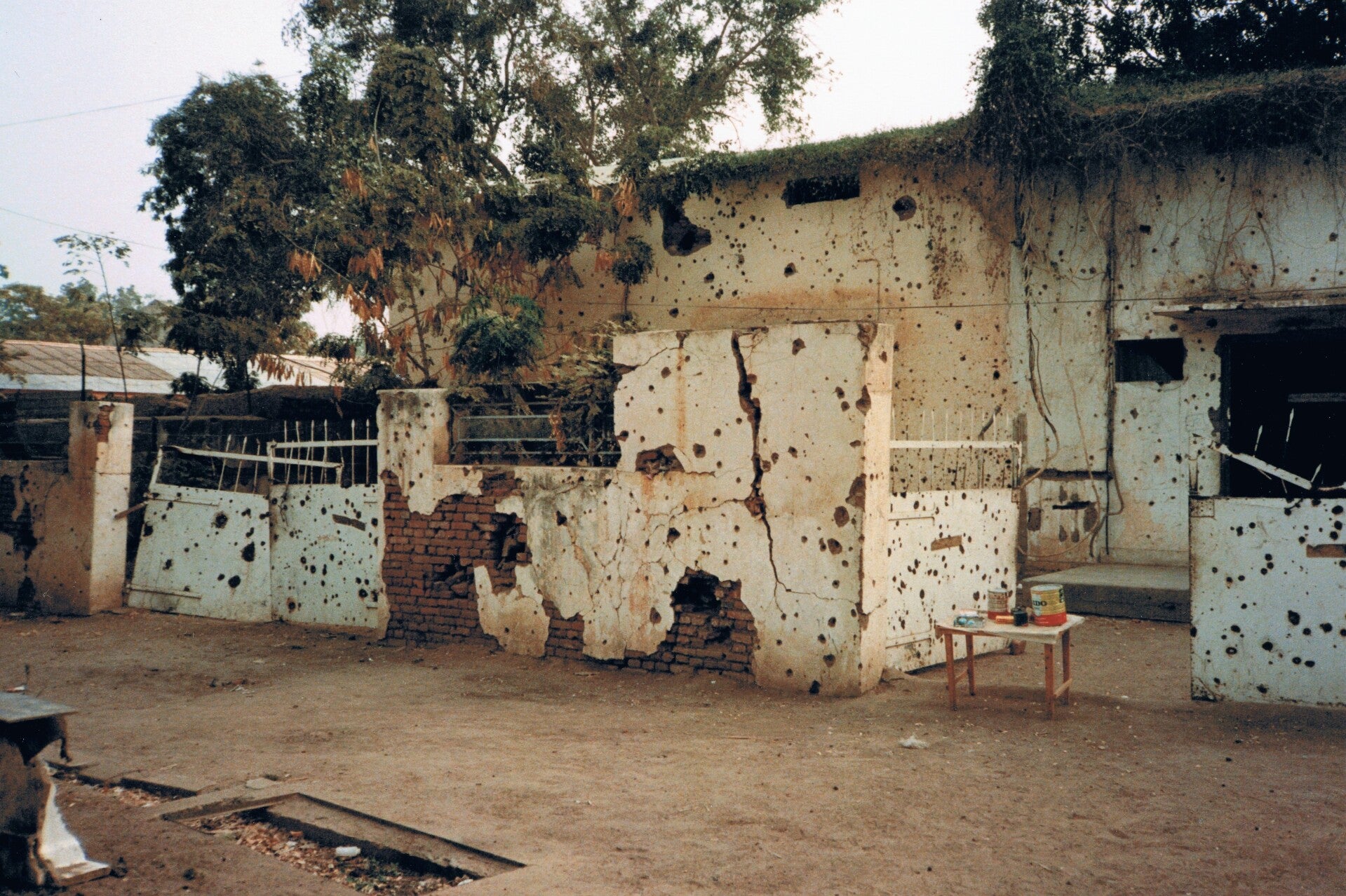
Financial, we headed into a battle-scarred city, the area close to our hotel decimated, with all manner of buildings from airline officers to restaurants to supermarkets drilled with bullet holes. Some buildings were lightly scarred, others blackened shells gutted by the fires that followed. Some businesses had patched up and moved back in and reopened but others had been left as they were and were abandoned or homes for squatters, their washing hung on the broken walls and balconies. In the main street, ruins were interspersed with new looking French supermarkets, patisseries and fruit and vegetable stalls which made the damage look even worse.
Metal gates were more holes than gate, the subject of some crazed gun shooting, perhaps, rather than a battle. Walking past one huge warehouse we could see through the holes in our side to the light shining through the holes on the other.
I cannot imagine what it was like to live through the various civil war battles over this city over the years. So much goes on around the world that reduces grand cities to rubble but those of us who live in relatively stable political environments hear little if anything. We are sheltered from firsthand experience of this kind of violence and often shamefully ignorant of troubles elsewhere unless our own countries are involved. If every battle made the news at home we would soon either become overwhelmed or just turn off and focus on our daily lives. I reckon seeing Ndjamena's battle scars is have more of an impact on us because of our recent close encounter with the Mali war.
And there were more surprises after the city's rough appearance. The post office was open and the staff charmingly careful and helpful if a little slow; one of them spoke excellent English but we had to resort to French to get directions to a photo shop. My quest for passport photos took me to three small shops, at the last of which I got 12 shots - for more visas! - for 1200 CFA in some interesting Tchadienne mathematical twist on 4 for 1000, in just 10 minutes.
Nearby was a yoghurt shop with three large freezers where two fruit yoghurts reduced Bob and I to pleasurable groanings so I bought a second serve. More joys awaited us when we finally made it to the elusive grand market: drink stands with blenders! A smiling man made us scrumptious milkshakes: pint glasses of delicious blends of bananas, water, powdered milk, ice cream and ice - yes, all the no no's of third-world travel but I was willing to risk it after my stomach’s great record so far. Jeff and I indulged toute sweet, Ton was convinced after seeing ours and Bob’s reluctance caved in to the sheer pleasure of a large glass of banana bliss, so cold it hurt to drink it!
What was left of the cinema was advertising two movies, including The Killing Fields.
Vicki and Adri are off to a party at the U.S. Embassy where they are getting additional passport pages tomorrow, taking Bob and Jim with them for company and protection. Physically not up to it with a rotten cold and not really sure if I want to go or not.
Our first night of 24-hour guard in camp and I got the 3:30 AM shift. I alternated between sitting round the fire and perambulating around the tent area, stout rubber torch in hand. The hushed tones of tent flaps heralded the arrival of the next shift and I tiptoed back to bed-and netting protection from biting beasties.
A passenger plane coming in to land at Ndjamena airport flew over us at rooftop level, it's lights reflecting in the river.

Add comment
Comments