Short drive to the border town of Ayorou where we filled in more forms and got more passport stamps - which, again, took forever. The officials seem incapable of doing anything efficiently and are more interested in rummaging through our lockers than actually searching for contraband.
Next stop was the Niger customs/police (undistinguishable which was which) before we arrived at Mali police stop (no marked border). Here we hung around in the sunshine while the Mali officials demonstrated their similar inefficiency. Walked through the little border village and the police area. Here were some gorgeous women in dark and black robes - in dramatic contrast to the bright colours of just yesterday - their hair plaited close to their scalps, their faces bearing tribal scarring, and silver and twisted leather jewellery at their wrists, ankles and necks. They were grinding something thick and gluggy with a huge pole in carved wooden containers. Didn’t look at all appetising but they ate it with relish.
While the border bigwig kept himself hidden in the border hut and Ben lounged in the doorway, just inside we could see five men, four wearing uniforms, the other a black and white kaftan, slouched in chairs, sipping coffees and talking loudly and expending as little energy as possible. Perhaps having more than one person doing paperwork at a time would reduce their efficiency further! The group of men then sauntered out of the office, Ben followed with our passports, and the police did a cursory search of the back of the truck, mentioning "cadeau" and, of course, ending up with another tape. Kelvin grumbled that he was quickly running out of gifts.
After what seemed an age, we were free to travel the short distance to customs where we all expected another long delay. But after the police bureaucracy, the customs officer told us to go straight through, and we entered Mali.
Lunched just over the border beside the Niger River - a beautiful, wide stretch of fast flowing water with boulders in the middle and reeds and flowers at the edge. The riverbank greenery was barely two metres wide before the colour disappeared again into desert. Only in areas of heavy agricultural irrigation does the river create an oasis any wider than its actual bed. Surprised that the wide expanse of water is not more utilised to produce more food.
Driving onwards we passed villages with very different storage containers than in Niger - made of mud but now smaller and with flat stones projecting from the walls all round, so they resembled lunar landing craft. Also, we started to see low, mat huts, taller in the centre but not high enough for an adult to stand up in. They were made of layers of the woven mats we’ve seen in the markets, with one large mat, often striped, stretched across the crown. The doorways were small but we could see a few shining utensils in the gloomy interiors.
The river-side village of Ansongo was fantastic. Kelvin gave us half an hour to wander along the river and try to absorb the movement, smells and colours of life by the water. It was so different from the dry villages we’ve seen before. The living space reached to water's edge and we got our feet wet navigating stalls selling dried fish, spread out to catch the sun (and the flies), and making way for locals at the one-way spots. There were also a few huts right beside the water, with women bent over doing laundry in the river and colourful clothes hanging out to dry. Some very old and wrinkled women sheltered in one of the huts. The whole arena smelt of fish and sewage-and garbage. As is now so familiar to us, we all became Pied Piper’s trailing smiling children who wanted to shake or hold our hands as we wandered.
Boats similar to Kashmir shikaras were moored along the shore and appeared to be used as taxis for both bodies and goods.
Out of town we passed many tiny collections of grass huts, the villagers warmly answering our waves and smiles.
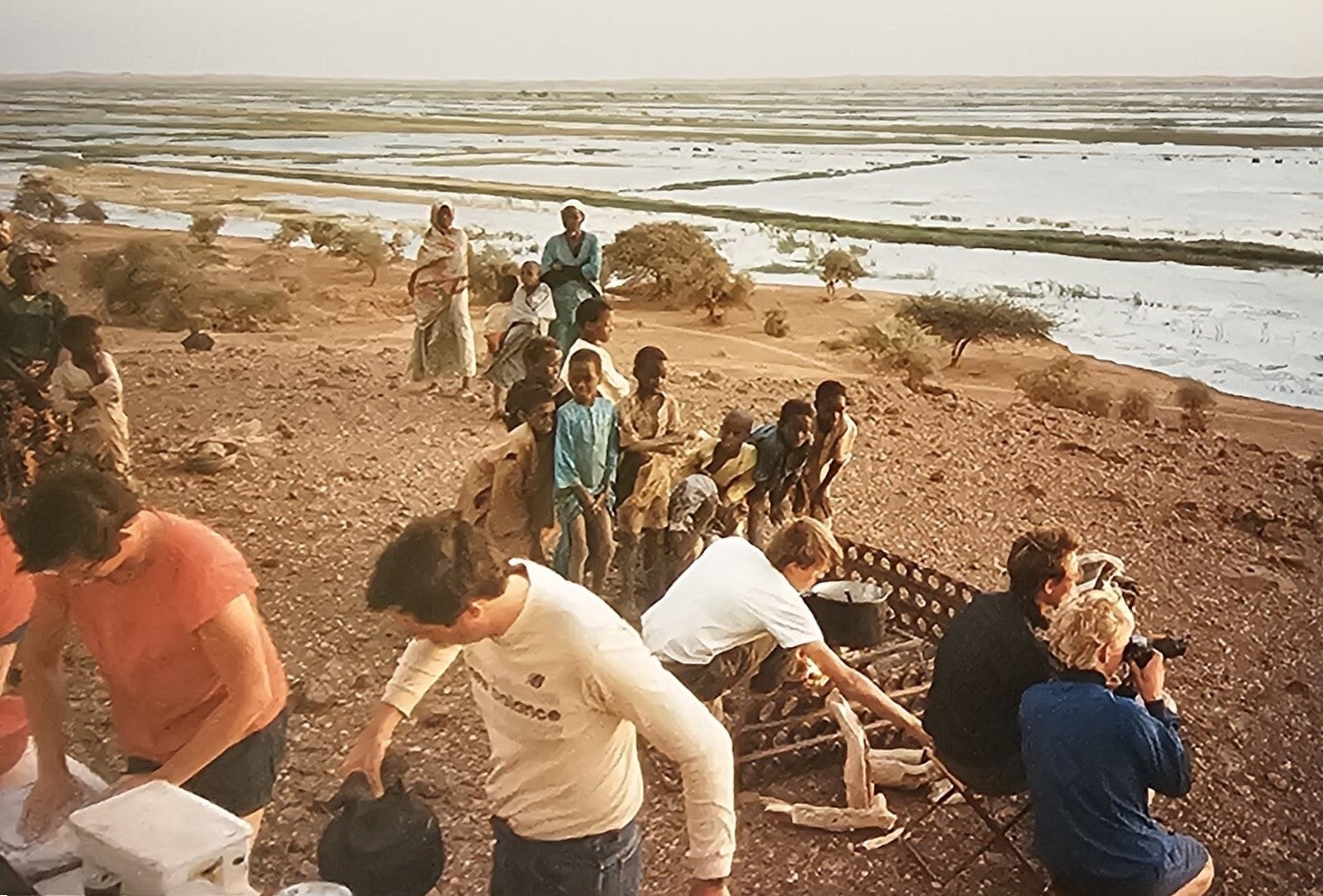
Finally made camp on a spectacular river embankment overlooking the weedy Niger. Views upstream and down of waterlogged groups of people seeming to live and farm small islands. Had a welcome wash and then sat up in the crows' nest watching the changes on the river as the sunset-colours changed from blue and red streaked clouds to very pale mauve; the river looked like running mercury, almost glowing, just before darkness.
Surrounded by local children, we helped make chapatis for fantastic curry dinner. Love this place.

Add comment
Comments