Walked on after breakfast, past the village of last night’s revelry where the drums were hung in the central palm tree. Closer inspection provided the solution to the metallic sound of last night: one of the drum skins was stretched over a small metal barrel, while the other two had traditional wooden bodies. The grey-haired old woman who danced in the shadows last night stood still in the village grounds now, watching me, and waved back.
Perhaps one continuous settlement strung along the road, tiny individual "villages" separated from each by only a few mostly red poinciana trees. Here were pineapple plants, coffee plants, bread fruit trees laden with large green fruits, huge clumps of bamboo bending up and out into huge green trees, frangipane plants in bright pink bloom, lush green grass that was almost luminescent against a stormy sky, tall grassy stalks topped with feathery bulrush-type heads, orange date-like fruit that we’ve seen for sale on the roadside. Thirty centimetre-high pineapples cost 25 Zaire (about A$0.80), bananas one cent each, and at the centre of every mini-market is manioc drying in the sun.
The hut styles became more distinct again with two marked types, including square huts with walls made from tall wooden poles and occasional crossing poles, sometimes filled in with the local mud (mostly red) but often left open to provide air flow for homes and churches, the sun casting crossed shadows on the ground inside where we could see people working. One church consisted simply of standing poles topped with a thatched roof sheltering primitive pews. Later in the day the more prominent style was round mud huts with perfectly trimmed thatch roofs, some of the walls painted with figurines and some geometric designs in chocolate brown. Through their narrow doorways we sometimes caught glimpses of fires burning inside. The huts have no chimneys so the smoke must collect in the hut before drifting out into the open.
In one village we again heard drumming. The source was two enormous water-filled drums similar to what I saw in the Bangui museum. A crowd gathered near the truck and some of them danced for us, two elderly women moving gently across in front of us. I noticed another albino child - they stand out among their dark-skinned family - and in several villages saw Downs Syndrome children. I wonder if this is a result of women here having children much later than many western women.
Butterflies drink from muddy puddles on the road, rising into colourful clouds around us when we drive through, occasional blue and black, and green and yellow ones adding dots of colours among more numerous brown ones. Looking down into occasional waterholes we could see the air moving with their fine wings around people washing in the brown waters.
Spent the morning in the crows' nest, quickly getting pink in the hot sun. Wonderfully view of the villages we passed, some with miniature cleared front "yards" with clipped shrub-lined “drives” and golden topped green bushes, and of occasional derelict Belgian brick farmhouses. We saw lots of women carrying enormous finely woven baskets - perhaps used for fishing - and some weaving them, and many of these baskets laying outside huts We passed a group of women walking away from their huts carrying baskets made from brown and golden reeds. We drove through vast areas where green grasses stretched to the jungle horizon, the ground rising into grassed peaks that we thought might be overgrown termite mounds or piles of road debris.
And then mid-afternoon the grey skies opened in a tropical downpour. I thought I could outlast it and just enjoy the experience but it got heavier, driving Jim and I out of the crows' nest and into the safety of the truck. The continuing rain forced us to drop Stanley’s repaired side tarpaulins and then even the back cover, leaving us cocooned. We occasionally lifted the back cover to watch the roads running with water and started to love at our naivety of the previous day when we thought Zaire would be too easy! Someone asked who had said they wanted to try mud matting.
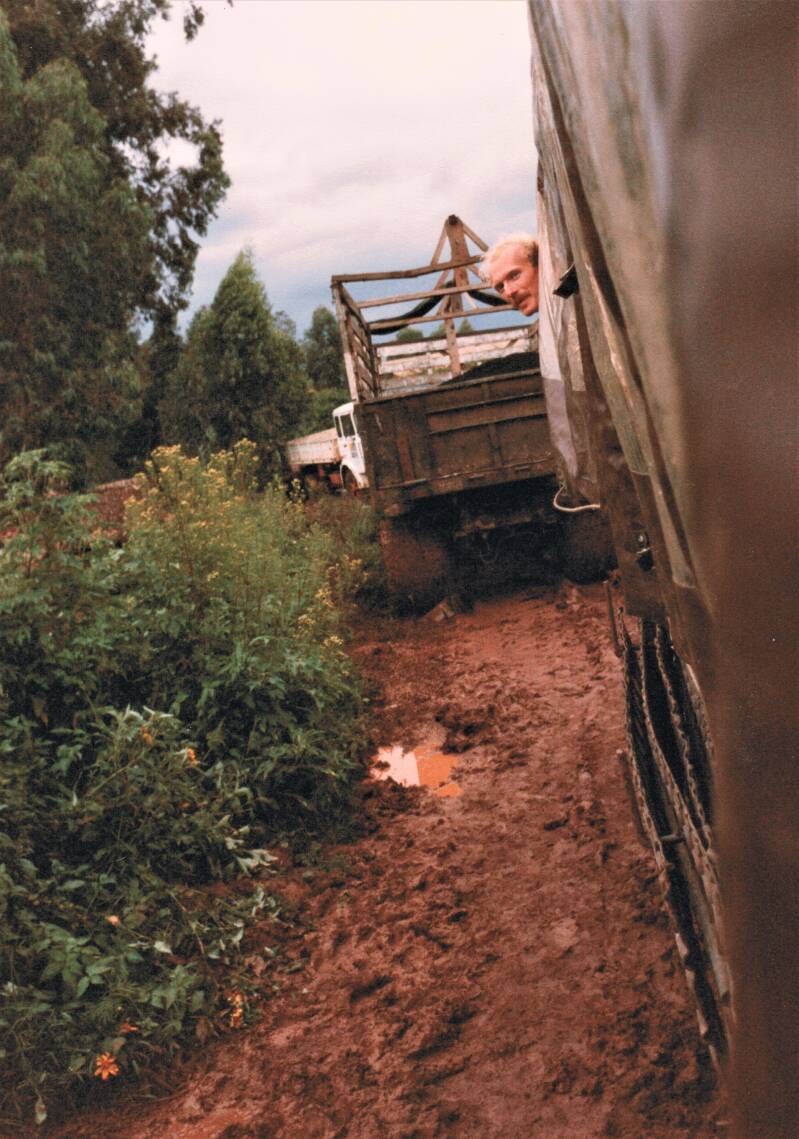
The road looked firm under the water, but passing a large truck we ploughed off the road surface, churned through the boggy edge and sank wheel-rim in mud, Stanley having slipped out of four-wheel-drive. We stuck our heads out the side to survey the situation: we were buried in a trench ploughed by the wheels. We thought we were up for our first mud matting but the other truck came back to check and offered to haul us to dryer ground.
Well, we ended up having to take the long-horned skull off the front of Stanley to give access to our twisted chain. Ben belted this under Stan’s rear and we all clambered out to watch and photograph our truck churning backwards and skewing further into the grassy bank, twisting slightly as the back wheels skidded. Finally on safer ground, we watched from a distance as Kel fought the wheel as Stanley slid sideways across the road before his wheels caught. We were all sodden and filthy with mud but in high spirits after our baptism in Zaire wet weather roads. Nikki and Kel were slightly blasé about just getting us out while the rest of us revelled in getting hauled out of our first bog.
The rain got even heavier and we watched from the back of the truck as our wheels left trenches behind in softened road - and occasionally slipped sideways. We pulled into another gravel pit just as the rain subsided.
Some of us washed in rainwater puddles, some sloshed water from jerry cans, before we cooked in the cook tent. After eating we listed to the Saturday night play on the BBC World Service as mozzies attacked us in the dark under the table.
Add comment
Comments