Early foggy ride on asphalt, arriving at the World Heritage Listed Palace D'Abomey Museum late morning, where we gained a fascinating insight into the three centuries of Benin royal life before French colonisation (12 successive kings from 1625 to 1900). The princely sum of CFA100 (30c) bought us a 75-minute guided tour through the two semi-restored palaces of the D'Abomey Kingdom, which originally covered 40 acres and were enclosed by a 7m high mud wall (see https://whc.unesco.org/en/list/323/).
Our first stop was a tiny building containing two sacred stones on which the famous D'Abomey warriors sharpened their weapons to bring them luck in battle before going to war. Next was a bizarre temple consisting of two circular chambers joined by a small mud archway, the entrances low so that worshippers had to crouch to their ancestral gods. But the eye-opener was the cob walls, which, our guide told us, contained saltwater, water from sacred rivers, gunpowder, alcohol and the blood of 41 enemy soldier prisoners. Three, 7, 16, 21 and 41 were sacred numbers with the biggest honour to the gods being the highest number, if it could be met, so 41 enslaved prisoners bit the dust. Each doorway had two wooden sentinels topped with hooks from which the chosen sacrifice was suspended so that the blood from their cut throats would cover the walls. So there I was, face to face with human sacrifice!
The throne "room" was actually a corridor lined with the thrones of the kings of D'Abomey from the early 1600s to the fall or French rule in the early 1900s. Most were similar low, squat wooden chairs but the first dramatic change was the throne of the king who fought and beat the Nigerian forces which had held power over D'Abomey. His throne stood on four skulls of defeated enemy soldiers. His mother's throne was similarly decorated. Behind each hung a huge, multi-coloured applique based on original designs depicting each king's chosen emblem (lion, buffalo, pineapple) and all sorts of weird warlike scenes of people without heads, heads in pots being beaten with their own legs, and even a twosome with someone shoving something up the other's backside (I could only guess at the significance of that one). Each throne had a matching umbrella that the queen held above the King’s head during council.+
Another room contained various gold covered beasts, and in another hall filled with canons we learned that the Portuguese arms dealers took humans as payment, the going rate being 15 men or 21 women (female slaves were roughly 3/4the value of male ones). Whenever I think of the horrendous industry of slavery, I remember Wilbur Smith's vivid descriptions of the sardine layers of men and women on the slave ships and the smell that preceded incoming slave transports, and my skin crawls.
Inside the second palace was a courtyard where the king's 4000 wives could chat and be washed by their 300 attending eunuchs. Here too was the communal grave of the 41 wives who fought for the privilege to die with the king: a now filled-in 5m-deep pit that was lined with luxurious carpets. Sat around the edge in lush clothes, the women were each given a strong poison to send them on their honourable way. Two comments when we entered this circular building containing the filled in grave illustrated two very different perspectives on this kind of history : Jim: “This is the most women I've ever walked on.” Ton: “Imagine the work to dig a five-metre pit.” With a strange smile on his face, our guide said that human sacrifice ceased in 1902 at French intervention, and without that would have continued to this day!
Further in was the tomb of the king whose wives are buried under that ground. Still today, female descendants of the royal line bring bed linen and special food and wine to honour the dead king, calling him down to eat and drink and sending him on his way again.
Another room contained weapons, two human skulls, a horsehair fly whisks, and a head crusher!
We walked along a corridor lined with jewellery and clothing, including warrior tunics. In the final chamber we found mobile altars similar to the “wind charms” we saw in the market but couldn’t identify. Also, four huge porcelain vessels sitting slightly on an angle so that their mouths could be hit with a leather strap, producing incredibly deep tones. These were traditionally used to inform the people of the death of their king. The original jar drums were pottery, but the Portuguese souvenired these and replaced them with porcelain ones.
After leaving the palace we walked through a small Artisan market selling weavings and applique. Kel bought a huge hat that provided shade for three people.
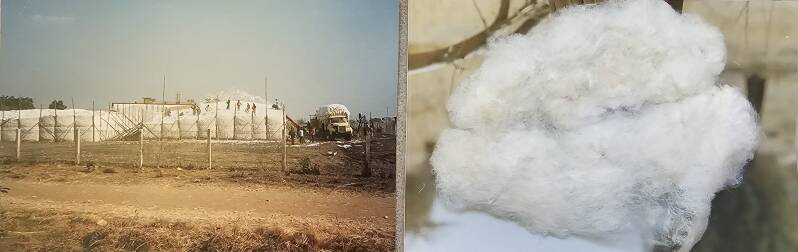
From there we drove on, abandoning bitumen for dirt road. We passed a huge cotton storage complex where a pump connected to a truck loaded with fluffy white balls was spewing cotton into a huge wire enclosure already piled high with cotton and men. We then passed a long line of parked trucks loaded with the fluffy white harvest.
Finally made camp and I sat up late writing this diary, comparing write ups of random days with Jim and Vicki. Lots of fun reminiscing about just a couple of months ago and seeing how differently we remember and recorded the trip.
Add comment
Comments