Initially it seemed that today would be a long hard drive with nothing much of interest but that soon changed.
We lost our way, briefly, trying to find a firmer route on our Michelin’s Map's sometimes barely visible rutted and sandy “recognisable track” - a new, alternate route for Kelvin. Pulled up beside a tiny village to ask directions and were instantly the focus of every child and young woman living there. They crowded beside the truck, smiling and seemingly as fascinated by us as we were by them, and not objecting to the cameras aimed at them.
We picked up two local men - one climbed into the cab and the other in the back as we took off - to guide us to the proper road. Almost immediately after, the truck violently breaking catapulted Ann from the crow’s nest onto the tents, bruising her arms and her cheek, injuring her back and breaking one of her fingers. Almost immediately after that we got badly bogged, prompting an early lunch stop. Marcus bought a pendant from one of our guides and our audience suddenly to seven men who appeared as if by magic from the barren landscape.
Soon came to a larger village with a modern mud-brick hospital, its walls a backdrop for children and ducks. Our guides directed us up one road but then turned us back another way, tunnelling beneath an overhanging tree that scratched all down my legs in the crows' nest. Police driving a hospital Land Rover then turned us back and we had to run the tree gauntlet again back into town.
There the gendarmes checked all our passports and several of the lockers, seemingly out of interest and probably boredom rather than looking for any contraband. During this I closely examined the buildings' mud walling: made of mud, stones, little prickle balls and even the odd piece of glass.
Cleared to proceed, we navigated the gauntlet of the trees a third time and headed into the wilds.
Passed fields fenced with thorn branches in which grew huge watermelons, their bright green leaves and huge fruit contrasting the gold and brown surrounding desert. We also passed little oases of unidentified plants, splashes of reds, browns and deep greens. Beyond a couple more villages we drove through expanses of millet and clusters of woven huts (storage or shelter) intricately woven from golden stalks and perched above ground on 1-foot stilts. Then a thorn bush that was just too low scratched my elbow and upper arm.
What a tough but stunning day, about 150km on our frequently disappearing “recognisable track” that immersed us in the sights and sounds and heat of Africa. Much harder on everyone and the truck so far than crossing the Sahara and a route Kel said he would not take again.
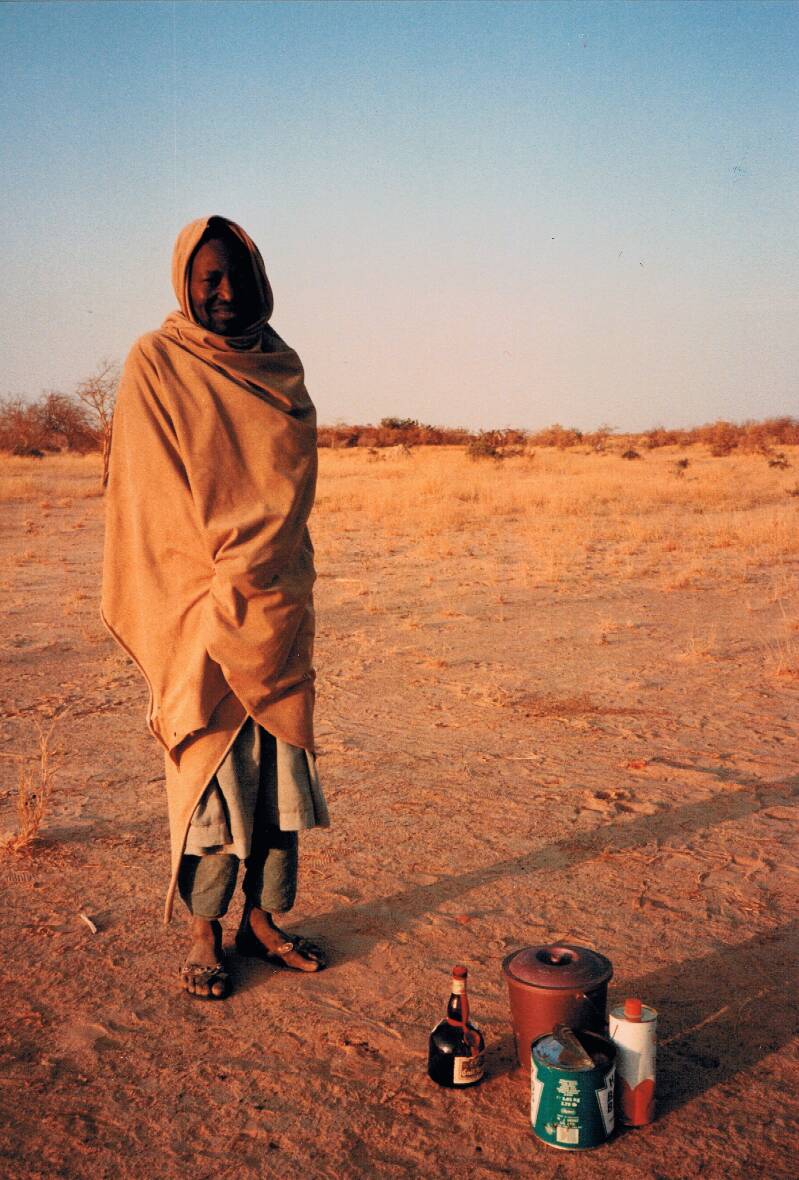
When we finally camped a man riding a camel man passed us, signalling that he would return. And he did, with a bucket of milk for us. We fed him soup and bread, potatoes and salmon patties, with hot tea. He ate with his back to us, silhouetted against the fire, but turned a bright white smile on us. It was a joy to share our food and fire with a local, no English being spoken, a mutual language unnecessary, sign language and the exchange of gifts all we needed.
Caption: The milk man with whom we shared a fire and swapped gifts.
Add comment
Comments